




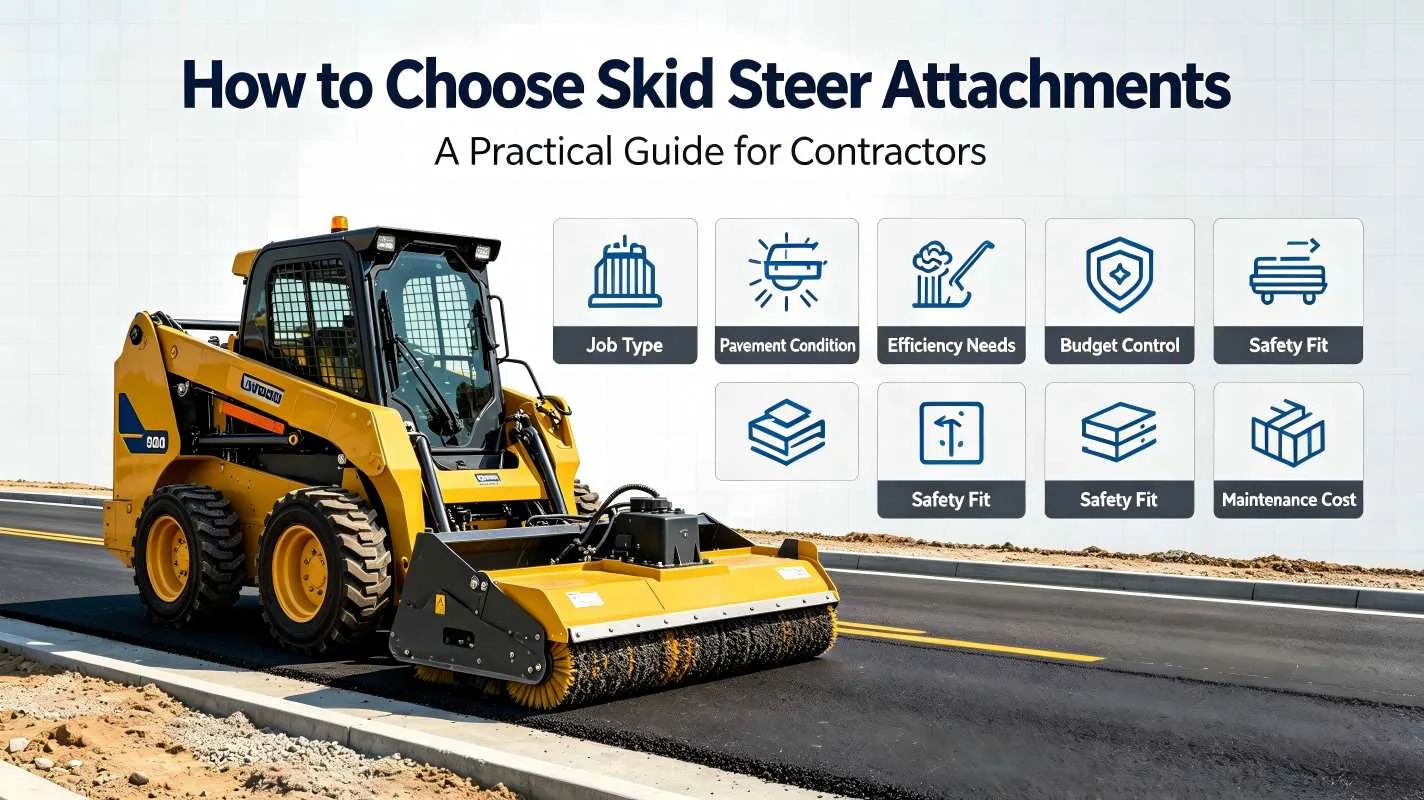
How to Choose Skid Steer Attachments for Road Maintenance: A Practical Guide for Contractors
Road maintenance rarely involves one single task. A contractor may need to remove damaged asphalt, repair pavement around manholes, cut narrow trenches, level aggregate, compact repaired surfaces, and clean debris from the work area—all on the same project.
A skid steer loader can handle many of these jobs when it is equipped with the right attachment. The challenge is choosing the attachment based not only on the job itself, but also on the loader's hydraulic capacity, attachment size, working depth, operating weight, mounting system, and the conditions of the road.
This guide explains how contractors, municipal operators, rental companies, equipment dealers, and fleet managers can select skid steer attachments for different road maintenance applications.
1. Start With the Road Maintenance Task
The first question should not be "Which attachment is the best?"
Instead, ask:
What exactly needs to be done to the road?
Different road maintenance operations require fundamentally different working tools.
| Road Maintenance Task | Suitable Attachment Type | Primary Function |
|---|---|---|
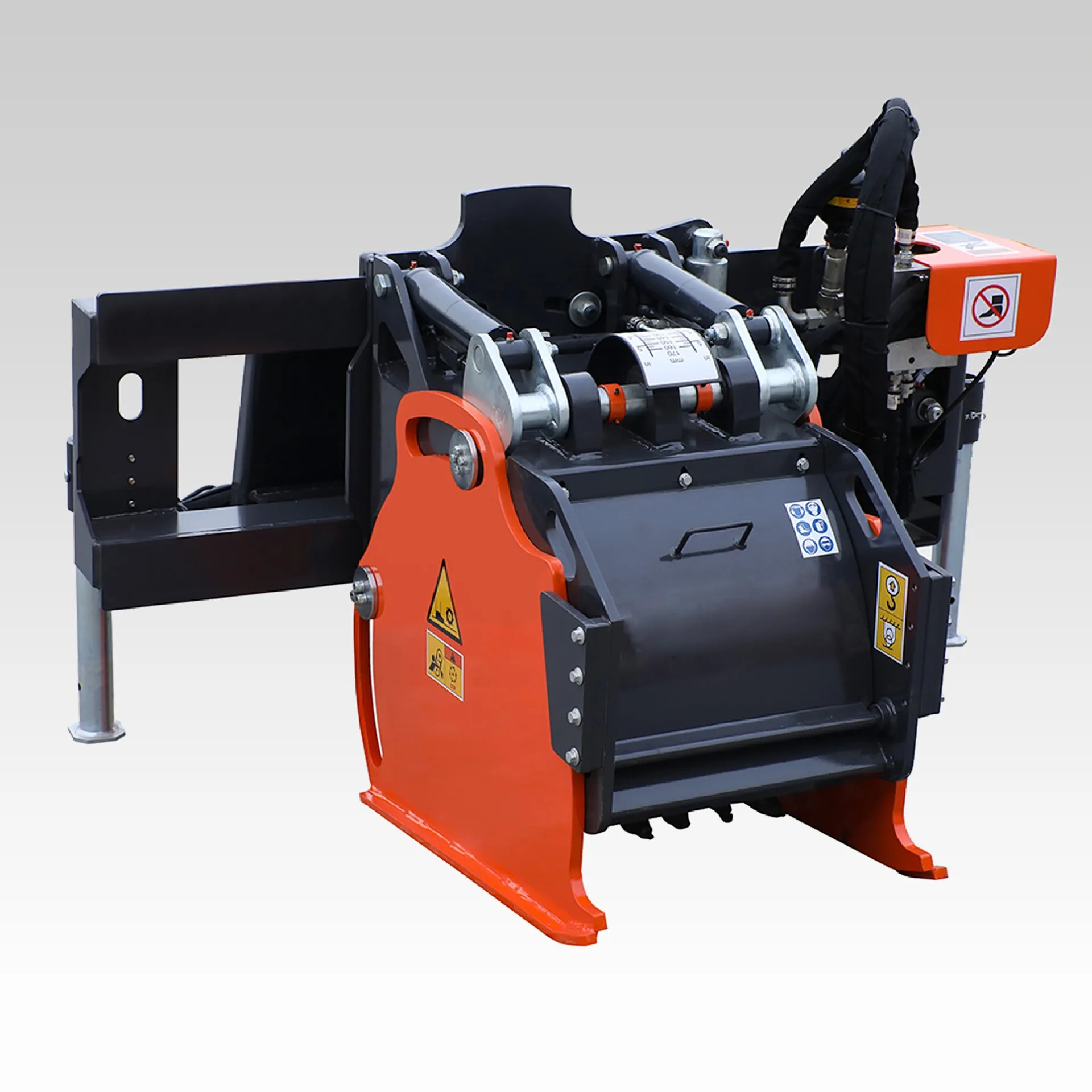
| Remove damaged asphalt | Cold Planer | Milling and surface removal |
| Repair pavement around manholes | Manhole Saw | Cutting concrete and asphalt around manhole covers |
| Cut narrow trenches | Wheel Saw | Pavement and ground trenching |
| Level and move material | Dozer Blade | Grading, backfilling and material pushing |
| Compact repaired surfaces | Vibratory Roller | Soil, aggregate and asphalt compaction |
| Remove loose debris | Sweeper / Angle Broom | Surface cleaning |
| Handle construction materials | Pallet Fork | Moving palletized and bulky materials |
HCN's current product range covers several of these applications, including the 0206 Series Cold Planer, 021560 Manhole Saw, Wheel Saw, 0309 Series Dozer Blade and 0205 Vibratory Roller.
The correct attachment therefore depends heavily on the specific operation rather than simply the size or horsepower of the skid steer.
2. Check Hydraulic Flow Before Ordering
For powered attachments, hydraulic compatibility is one of the most important purchasing considerations.
A skid steer may physically accept an attachment through its quick-attach system, but that does not automatically mean the machine can operate the attachment correctly.
Before ordering, compare:
Auxiliary hydraulic flow
Maximum operating pressure
Attachment hydraulic flow requirement
Case drain requirements, where applicable
Electrical/control requirements
Machine operating capacity
Attachment operating weight
This is particularly important for road maintenance attachments because several of the tools used for milling, trenching and compaction require substantial hydraulic performance.
HCN example: 0206 Series Cold Planer
HCN's 0206 Series Cold Planer currently lists three models:
| Model | Working Width | Working Depth | Hydraulic Flow | Pressure | Weight |
|---|---|---|---|---|---|
| 020612 | 300 mm | 150 mm | 120–130 L/min | 21 MPa | 580 kg |
| 020618 | 450 mm | 150 mm | 130–140 L/min | 21 MPa | 887 kg |
| 020620 | 500 mm | 150 mm | 130–140 L/min | 21 MPa | 980 kg |
The three models have the same listed overall dimensions, but their working widths, hydraulic requirements and weights differ.
That is an important purchasing lesson:
Do not treat an attachment series as if every model has the same hydraulic requirement.
The machine should be matched to the specific model being purchased.
For example, a contractor comparing the 020612 and 020620 should not simply ask whether the skid steer is "large enough." The auxiliary hydraulic flow, attachment weight and required working width should all be checked against the specific machine.
If your machine's hydraulic specification is unclear, obtain the exact auxiliary flow and pressure information from the machine manufacturer or dealer before ordering.
3. Choose the Cold Planer by Working Width and Job Size
Cold planers are particularly useful when a contractor needs to remove damaged pavement without bringing a large dedicated milling machine onto a smaller jobsite.
HCN describes its cold planers for applications including asphalt and concrete repair, pothole and frost-heave repair, curb cutting, pavement texturing, traffic-lane stripe removal and work around manholes. The product range also includes side-shift and depth-control functions on applicable configurations.
When a narrower planer makes sense
A narrower drum can be useful when:
Repair areas are relatively narrow
Access is restricted
Small sections of pavement must be removed
The contractor needs greater maneuverability
The job does not justify a dedicated milling machine
HCN's 020612 provides a 300 mm working width and 150 mm working depth.
When a wider planer makes sense
A wider working width can improve productivity when:
Larger pavement sections must be milled
The jobsite provides sufficient working space
The skid steer has adequate hydraulic capacity
Higher production is more important than working in very confined areas
The 020618 and 020620 models provide 450 mm and 500 mm working widths respectively, with listed hydraulic flow requirements of 130–140 L/min.
The correct choice is therefore a balance between production width, machine capability and site access.
4. Use a Manhole Saw When the Repair Is Concentrated Around the Manhole
Manhole repair is a good example of why choosing an attachment according to the exact task can make a major difference.
HCN's 021560 Manhole Saw is designed to remove the collar and surrounding concrete or asphalt around manhole covers. The product page states that it is designed as a heavy-duty skid steer attachment and includes a hydraulic-powered breakout feature and a self-aligning hydraulic clamp. It also lists a cutting depth of up to 14 inches.
This type of attachment is fundamentally different from a general cold planer.
A cold planer is designed to mill pavement over a broader working area.
A manhole saw is designed around a much more specific repair operation.
For contractors performing frequent municipal or utility work, this distinction can affect:
Labor requirements
Repair time
Pavement disturbance
Operator control
Equipment utilization
Instead of selecting a general-purpose attachment and adapting it to every job, consider whether a dedicated attachment can perform the specific operation more efficiently.
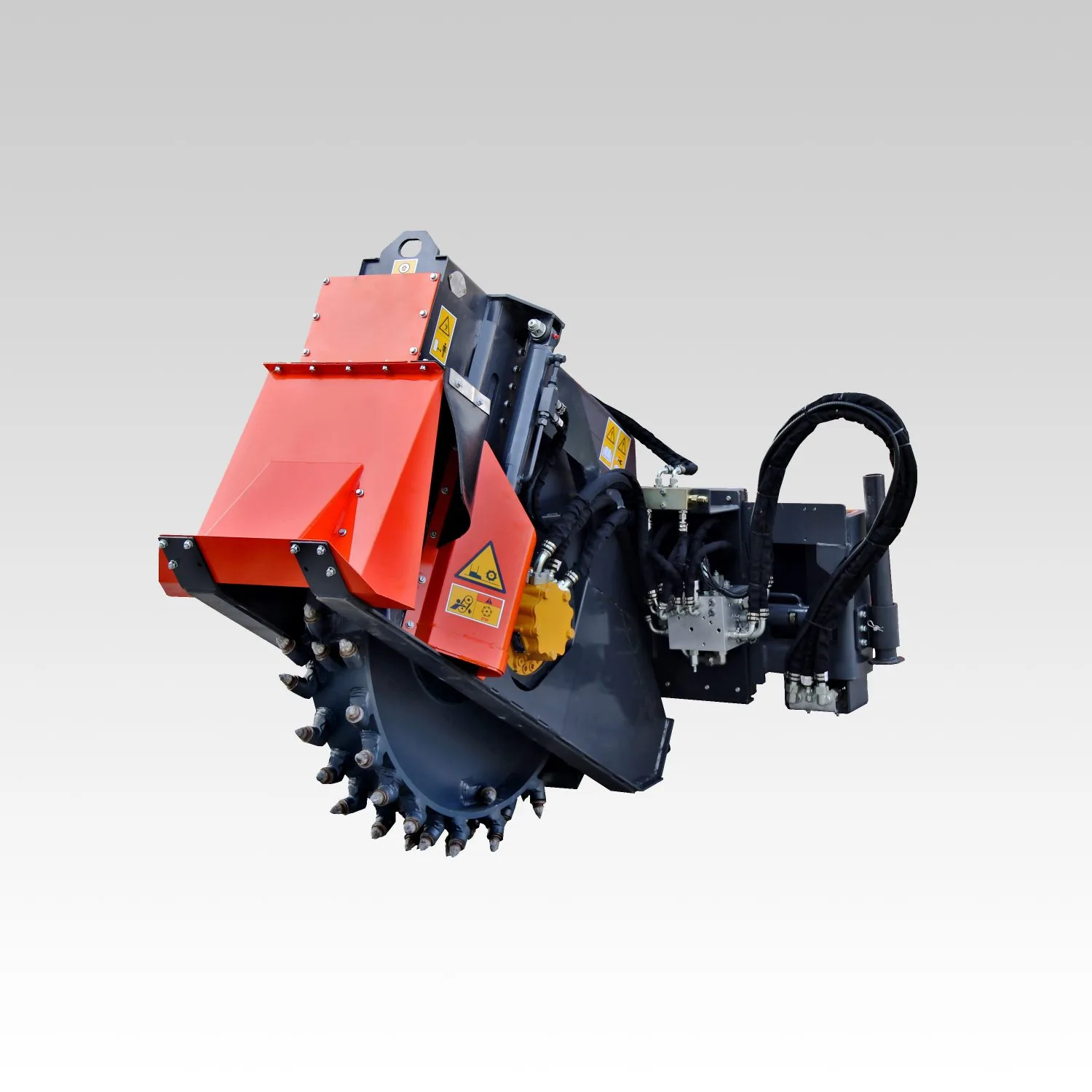
5. Use a Wheel Saw for Narrow Pavement Cuts and Trenching
A wheel saw is another specialized road-maintenance tool.
HCN's Wheel Saw uses a hydraulic motor to drive a carbide-tipped cutting wheel. The product page describes applications including asphalt, frozen ground and hard soils containing gravel, with hydraulic depth control and hydraulic side-shift.
The current specifications list several configurations:
| Model | Trenching Width | Trenching Depth | Weight | Hydraulic Flow |
|---|---|---|---|---|
| 030508I | 30 mm | 350 mm | 400 kg | 40–80 L/min |
| 030512I | 50 mm | 350–450 mm | 600 kg | 60–120 L/min |
| 030512IA | 80 mm | 450–600 mm | 700 kg | 60–120 L/min |
| 030516I | 100 mm | 450–600 mm | 1,100 kg | 90–150 L/min |
All listed configurations have a working pressure of 21 MPa.
These specifications demonstrate why attachment selection should be based on the actual model.
The 030508I and 030516I are not interchangeable from a machine-selection perspective. Their weight, cutting dimensions and hydraulic flow requirements are substantially different.
For a contractor purchasing a wheel saw, the procurement checklist should therefore include:
Required trench width
Required trench depth
Available auxiliary flow
Available operating pressure
Loader capacity
Required side-shift range
Trench-cleaning requirements
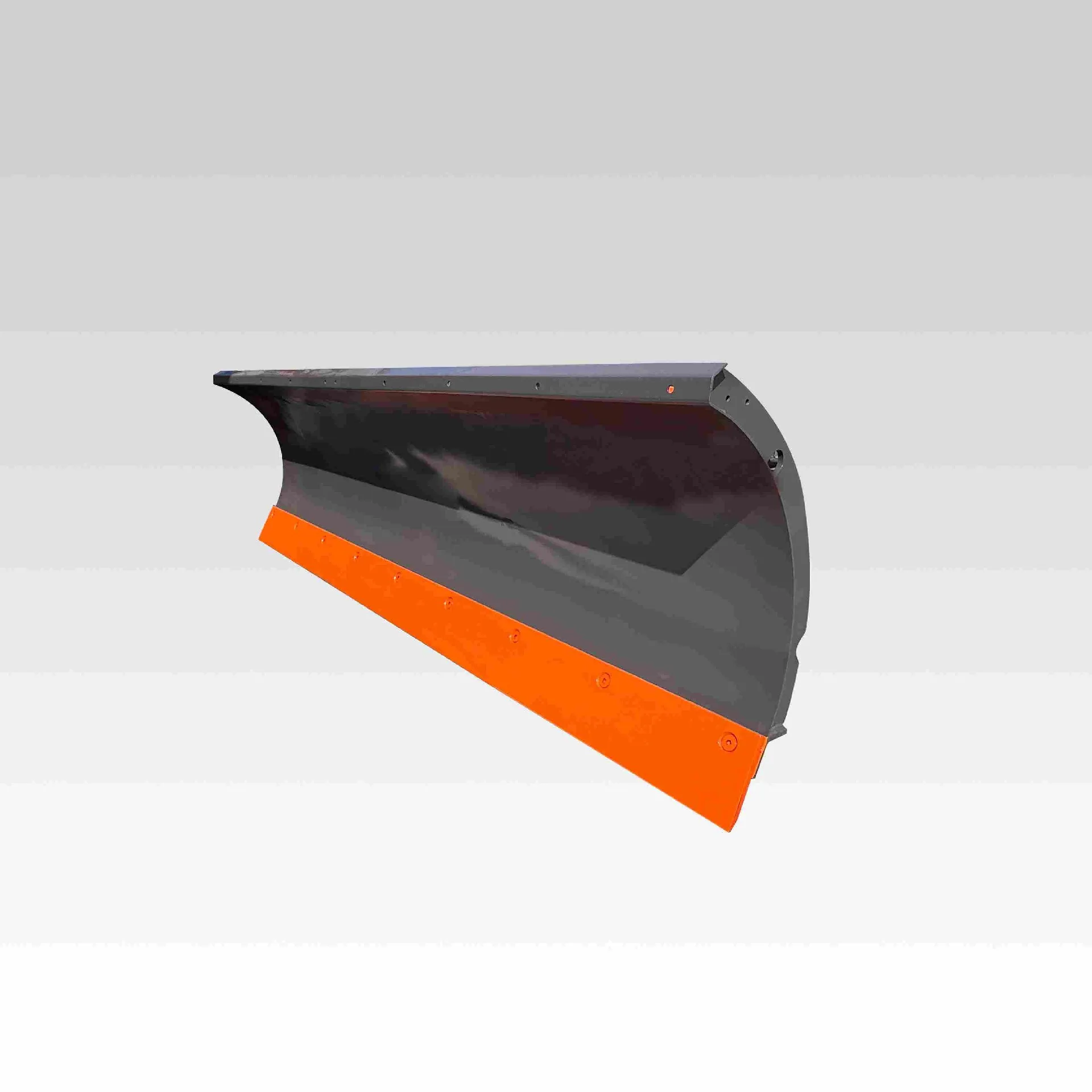
6. Use a Dozer Blade for Grading, Backfilling and Material Distribution
Not every road-maintenance operation requires a high-flow hydraulic attachment.
For grading and material movement, a dozer blade can be a more appropriate solution.
HCN's 0309 Series Dozer Blade is designed for grading, leveling, backfilling and material movement. The current product page lists four models from 1530 mm to 2400 mm overall width. Each model has ±30° deflection and ±10° maximum yaw, with a listed hydraulic flow requirement of 20–30 L/min.
| Model | Overall Width | Weight | Working Flow |
|---|---|---|---|
| 030960 | 1530 mm | 525 kg | 20–30 L/min |
| 030972 | 1830 mm | 556 kg | 20–30 L/min |
| 030984 | 2130 mm | 575 kg | 20–30 L/min |
| 030996 | 2400 mm | 625 kg | 20–30 L/min |
This makes the dozer blade a useful example of another important selection principle:
A larger attachment does not automatically mean a higher hydraulic-flow requirement.
The working tool's design and hydraulic functions determine the actual hydraulic requirement.
For contractors performing grading and road-base preparation, blade width should therefore be considered together with machine width, site access, required working angle and material conditions.
7. Match the Compaction Attachment to the Machine and Material
After milling, trenching or grading, compaction may become the next critical operation.
HCN's 0205 Vibratory Roller is designed for skid steer loaders and small wheel loaders and is positioned for applications including roadways, walkways, bike paths, bridges, parking lots and landscaping.
The current specifications include:
| Model | Overall Length | Weight | Dynamic Force | Working Flow | Pressure |
|---|---|---|---|---|---|
| 020560 | 1760 mm | 890 kg | 31 kN @ 60 | 60–70 L/min | 20 MPa |
| 020572 | 2060 mm | 955 kg | 37 kN @ 60 | 60–70 L/min | 20 MPa |
Both models are listed as suitable for skid loaders and small wheel loaders.
When choosing a vibratory roller, do not evaluate the attachment only by drum width.
Also consider:
Material being compacted
Required compaction level
Available hydraulic flow
Attachment weight
Machine stability
Working width
Site access
Smooth drum or pad-foot configuration
The correct attachment should provide the required compaction performance without exceeding the carrier machine's operating limits.
8. Attachment Weight Is Just as Important as Hydraulic Flow
Hydraulic compatibility is only one part of the equation.
Attachment weight affects:
Machine stability
Lift capacity
Transport behavior
Forward visibility
Ground pressure
Operator control
Consider the difference between HCN's 020612 Cold Planer at 580 kg and the 020620 at 980 kg. Both belong to the same product series, but the weight difference is significant.
The same principle applies to the Wheel Saw range, where listed weights extend from 400 kg to 1,100 kg.
Therefore, a machine may have enough hydraulic flow for an attachment but still not be the right carrier for that attachment.
Before purchasing, verify the loader's rated operating capacity and the manufacturer's approved attachment compatibility.
9. Don't Assume Every Attachment Requires High Flow
One common purchasing mistake is to assume that high-flow hydraulics are always better.
They are not.
The correct approach is to match the machine's hydraulic system to the attachment's specified operating range.
HCN's product range demonstrates the difference.
The 0206 Cold Planer requires approximately 120–140 L/min depending on the model, while the 0309 Dozer Blade lists 20–30 L/min.
The HCN 0205 Vibratory Roller is listed at 60–70 L/min, while the 052840 Boom Mower requires 75–100 L/min.
This means that attachment selection should begin with the actual hydraulic requirement of the attachment, not simply the assumption that "more hydraulic flow is better."
10. Consider the Complete Road-Maintenance Workflow
For contractors, the best attachment is not necessarily the one that performs one task fastest.
It may be more valuable to consider the complete workflow.
For example, a pavement repair project could involve:
Milling → Cutting → Material Handling → Grading → Compaction → Cleanup
A skid steer equipped with the appropriate attachments can support several stages of this workflow.
Example workflow
Step 1 — Remove damaged pavement
Use a cold planer when controlled pavement removal is required.
Step 2 — Perform localized cutting
Use a manhole saw or wheel saw where the repair requires specialized cutting.
Step 3 — Move material
Use a bucket or pallet fork where material handling is required.
Step 4 — Grade and distribute material
Use a dozer blade to spread or level suitable material.
Step 5 — Compact the repaired surface
Use a vibratory roller for appropriate compaction work.
Step 6 — Clean the work area
Use a sweeper or broom attachment to remove loose material and debris.
This approach turns attachment selection into a fleet-management decision rather than an isolated product purchase.
11. A Practical Skid Steer Attachment Selection Checklist
Before requesting a quotation, prepare the following information.
Machine information
Machine manufacturer
Machine model
Model year
Rated operating capacity
Auxiliary hydraulic flow
Maximum auxiliary hydraulic pressure
High-flow or standard-flow configuration
Quick-attach type
Electrical connection requirements
Job information
Primary application
Material being processed
Required working width
Required working depth
Required production level
Available working space
Ground or pavement conditions
Frequency of use
Attachment information
Attachment model
Operating weight
Hydraulic flow requirement
Operating pressure
Working dimensions
Mounting requirements
Optional equipment
Wear parts and maintenance requirements
Providing these details to the attachment manufacturer can significantly reduce the risk of ordering an unsuitable configuration.
12. Common Purchasing Mistakes
Mistake 1: Choosing by physical fit only
A quick-attach plate may fit while the hydraulic system does not.
Mistake 2: Choosing the largest model automatically
A larger attachment may increase productivity in some applications, but its additional weight and hydraulic requirements may make it unsuitable for a smaller loader.
Mistake 3: Looking only at hydraulic flow
Flow is important, but pressure, attachment weight, machine capacity and mounting compatibility matter too.
Mistake 4: Ignoring the exact model
A product family can contain several models with different specifications.
HCN's 0206 Cold Planer and Wheel Saw ranges demonstrate this clearly.
Mistake 5: Buying for a hypothetical job
For contractors and rental fleets, attachment utilization matters. A highly specialized attachment may make sense when it will be used regularly, while a less frequently required tool may need a different purchasing strategy.
13. How to Request the Right Attachment From HCN
If you are sourcing an attachment for a specific skid steer, the most useful information to provide is not simply the machine brand.
Send the attachment manufacturer:
Machine make + model + hydraulic flow + hydraulic pressure + primary application + required working width/depth + expected working conditions.
For example:
Machine: [your skid steer model]
Auxiliary flow: [L/min or GPM]
Auxiliary pressure: [MPa or PSI]
Application: asphalt road repair
Required attachment: cold planer
Required working width: approximately [width]
Required working depth: approximately [depth]
HCN can then help determine which configuration is appropriate.
If the machine specification or attachment requirement is unclear, do not assume compatibility. Ask HCN to confirm the exact model and configuration before placing an order.
FAQ
1. What should I check first when buying a skid steer attachment?
Start with the actual application, then check the machine's auxiliary hydraulic flow, pressure, rated operating capacity, mounting system and physical dimensions against the attachment's specifications.
2. Do all skid steer attachments require high-flow hydraulics?
No. Hydraulic requirements vary significantly between attachment types and models. For example, HCN's 0309 Series Dozer Blade lists 20–30 L/min, while its 0206 Cold Planer models require approximately 120–140 L/min.
3. Which HCN attachment is suitable for asphalt milling?
HCN's 0206 Series Cold Planer is designed for asphalt and concrete milling applications, including pavement repair, removal of deteriorated pavement and other road-maintenance operations. Different models have different working widths and hydraulic requirements.
4. What attachment should I use for manhole repair?
The HCN 021560 Manhole Saw is specifically designed to remove the surrounding concrete and asphalt around manhole covers.
5. What is a wheel saw used for?
A wheel saw is designed for narrow cutting and trenching applications. HCN's Wheel Saw range provides different trench widths and depths and uses hydraulic drive, depth control and side-shift functions.
6. Can a skid steer use a vibratory roller for road maintenance?
HCN's 0205 Vibratory Roller is listed for skid loaders and small wheel loaders and is designed for applications including roadways, walkways, parking lots and other surfaces requiring compaction.
7. How do I know which HCN attachment model fits my machine?
Compare the specific attachment model's hydraulic flow, operating pressure, weight, dimensions and mounting requirements with the specifications of your exact machine. If any specification is unavailable, contact HCN with your machine model and hydraulic information for confirmation.
8. Can one skid steer handle several road-maintenance attachments?
Yes, provided each attachment is compatible with the machine. One skid steer can be configured for different tasks using different attachments, but each attachment should be evaluated separately for hydraulic requirements, weight, mounting compatibility and application suitability.
Conclusion
Choosing a skid steer attachment for road maintenance is fundamentally a matching exercise.
The right decision connects four elements:
Machine capability → Attachment requirements → Job conditions → Required result
A cold planer may be the right solution for pavement removal, while a manhole saw is better suited to localized manhole repair. A wheel saw can address narrow trenching requirements, a dozer blade can support grading and backfilling, and a vibratory roller can handle appropriate compaction work.
The important point is that there is no universal "best" road-maintenance attachment.
The best attachment is the one whose hydraulic requirements, dimensions, weight, working range and mounting system match the carrier machine and the actual job.
For contractors, equipment dealers, rental fleets and municipal operators, this approach can reduce compatibility problems and help build a more productive attachment fleet.
If you are selecting an attachment for a specific skid steer, provide HCN with your machine model, auxiliary hydraulic flow, hydraulic pressure and application requirements so the appropriate attachment configuration can be confirmed before purchase.
 +86 185 5285 3111
 +86 185 5285 3111
 nancy@hcn-tech.com
