




Snow Blower vs. Snow Blade: How to Choose the Right Attachment for Commercial Snow Removal
Winter maintenance contractors, equipment dealers, rental companies, and municipal fleet operators often face an important purchasing decision: should they invest in a hydraulic snow blower or a snow blade?
Both attachments are designed to remove snow, but they work in fundamentally different ways. A snow blade pushes snow across a surface and moves it to the side, while a snow blower collects snow mechanically and discharges it through a chute.
Choosing the right attachment depends on more than machine horsepower or attachment width. Snow conditions, clearing distance, available storage space, hydraulic capacity, carrier compatibility, operating weight, and the size of the area being maintained all influence the decision.
This guide compares snow blowers and snow blades, explains their technical differences, and provides practical purchasing considerations using HCN's actual 0209H Snow Blower and 0208I Snow Blade product specifications.
1. Understanding the Difference Between a Snow Blower and a Snow Blade
Before comparing technical specifications, it is important to understand how each attachment removes snow.
1.1 Snow Blower: Collect and Discharge Snow
A hydraulic snow blower uses a rotating auger to collect snow and a high-speed fan to discharge it through an adjustable chute.
Instead of simply moving snow toward the edge of a road or parking lot, the attachment can throw snow away from the cleared area.
This makes a snow blower particularly useful when:
Removing thick accumulations of snow.
Handling heavy, wet, or compacted snow under suitable operating conditions.
Clearing roads and large parking areas where snow cannot simply be pushed to the side.
Removing snow from narrow areas where piling snow along the edges would restrict access.
Directing snow toward a designated storage area.
HCN's 0209H Snow Blower uses a toothed auger, a four-blade fan, direct-drive hydraulic motors, and a hydraulically controlled discharge chute.
The product specification lists a maximum chute rotation of 270° in the low-throw configuration and 200° in the high-throw configuration.
This allows operators to control where discharged snow is directed, subject to the selected configuration.
1.2 Snow Blade: Push and Move Snow
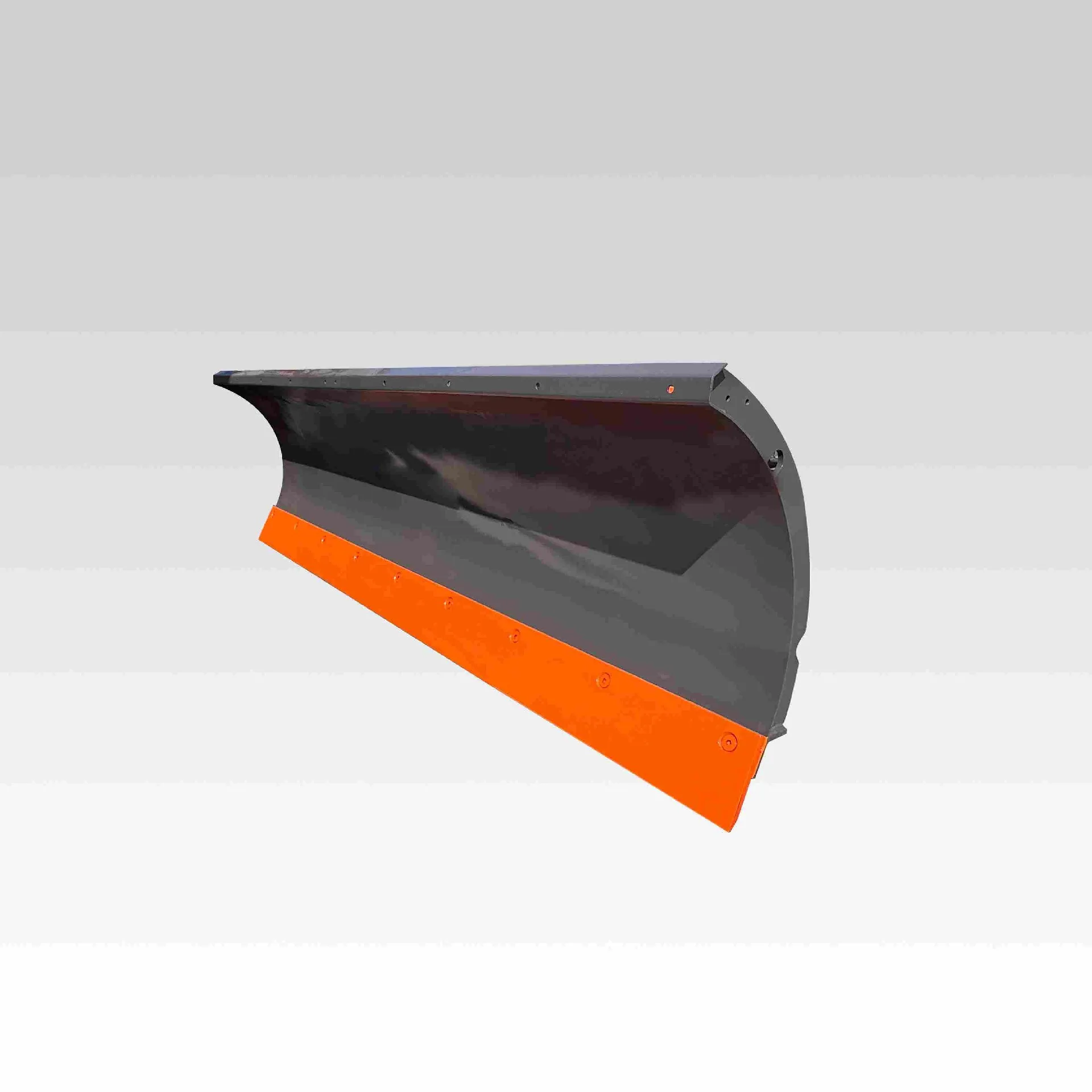
A snow blade removes snow by pushing it forward or directing it sideways.
Its angled moldboard moves snow away from the working path, allowing operators to clear roads, driveways, parking areas, and other accessible surfaces.
A snow blade is particularly useful for:
Routine snow clearing after light or moderate snowfall.
Clearing long, relatively open surfaces.
Moving snow toward designated roadside or parking-area storage locations.
Repeated maintenance passes.
Operations where a straightforward pushing action is sufficient.
HCN's 0208I Snow Blade features hydraulic angle adjustment of up to 30° in either direction, replaceable wear edges, adjustable skid shoes, and a spring-loaded trip mechanism.
The trip mechanism helps the blade respond when it encounters an obstruction, reducing the risk of impact damage.
2. Snow Blower vs. Snow Blade: Technical Comparison
The following table compares the two HCN product lines using their published product information.
| Comparison | HCN 0209H Snow Blower | HCN 0208I Snow Blade |
|---|---|---|
| Working principle | Collects and throws snow | Pushes and redirects snow |
| Main application | Snow removal with controlled discharge | Snow clearing and pushing |
| Suitable snow conditions | Heavy, wet, loose and accumulated snow, subject to conditions | Light to moderate snow clearing |
| Discharge control | Hydraulic chute and deflector | Hydraulic blade angle |
| Hydraulic flow | 75–150 L/min | Not specified on current product page |
| Published pressure | Maximum 20 MPa | Working pressure 14–21 MPa |
| Model width range | 1,896–2,200 mm | 1,575–2,430 mm |
| Published operating weight | 520–600 kg | 280–325 kg |
| Hydraulic adjustment | Chute rotation and deflector | Blade angle up to ±30° |
| Main advantage | Controlled snow discharge | Straightforward pushing and clearing |
The two products should not be treated as interchangeable. Their working mechanisms, hydraulic requirements, and operating characteristics are different.
The snow blower's flow requirement is especially important. Buyers should not assume that a machine capable of operating a hydraulic snow blade can also power the 0209H Snow Blower.
Source: HCN's published 0209H Snow Blower and 0208I Snow Blade specifications.
3. Which Attachment Is Better for Different Snow Conditions?
Snow conditions are among the most important factors when choosing a snow removal attachment.
3.1 Light Snowfall
For routine clearing after light snowfall, a snow blade is often a practical choice.
It can push snow toward the edge of a driveway, road, or parking area without requiring the auger and fan mechanism used by a snow blower.
For contractors maintaining several commercial properties, a blade can be useful for repeated clearing operations where snow accumulation remains manageable.
The HCN 0208I Snow Blade includes adjustable skid shoes and a replaceable cutting edge, supporting adjustment and maintenance for different surface conditions.
3.2 Heavy Snow Accumulation
When snowfall becomes deeper or more difficult to move, a snow blower may offer operational advantages.
A blade can push snow only as far as the available working space and storage areas allow. As snow accumulates along the edges, available clearing space can become increasingly restricted.
A snow blower can collect snow and discharge it to a selected location, helping avoid continuously building large snowbanks along the cleared route.
HCN describes its 0209H Snow Blower for thick, heavy, wet, dirty, and loose snow applications.
However, actual performance depends on snow density, temperature, machine hydraulic output, travel speed, and operating conditions.
3.3 Wet and Compacted Snow
Wet snow can be particularly challenging because it is heavier and may place greater demands on the attachment.
The 0209H uses a toothed auger and four-blade fan. HCN also describes a dual-motor direct-drive arrangement and an adaptive hydraulic system intended to balance snow feeding and discharge.
This design is intended to help manage snow feeding when the fan encounters excessive material.
Operators should still avoid deliberately feeding stones, large debris, or foreign objects into the attachment.
3.4 Narrow Areas and Restricted Storage Space
The availability of snow storage space can change the economics of a snow removal operation.
For example, a contractor maintaining a large parking lot may initially find that pushing snow to the perimeter is sufficient.
After several snowfalls, however, the accumulated snowbanks may reduce parking capacity, restrict visibility, and interfere with vehicle movement.
In such circumstances, a snow blower may provide a more flexible way to relocate snow.
The important purchasing question is not simply how much snow the machine can move, but where that snow can be placed.
4. How to Choose the Right HCN Snow Blade Model
HCN's 0208I Snow Blade range includes four published configurations.
The correct model should be selected according to the required clearing width, available machine capacity, and working environment.
| Model | Overall Width | Working Width at 30° | Weight |
|---|---|---|---|
| 020860I | 1,575 mm | 1,300 mm | 280 kg |
| 020872I | 1,830 mm | 1,580 mm | 295 kg |
| 020884I | 2,130 mm | 1,845 mm | 312 kg |
| 020896I | 2,430 mm | 2,100 mm | 325 kg |
Other published specifications include:
Overall length: 1,010 mm.
Transport height: 635 mm.
Overall height: 978 mm.
Hydraulic deflection angle: ±30°.
Working pressure: 14–21 MPa.
Maximum listed against-obstacle height: 80 mm.
How to select the width
Smaller working areas
A narrower blade may be more appropriate for restricted access, smaller parking areas, and narrow roads.
Medium-sized commercial areas
The 020872I and 020884I provide intermediate working widths for contractors maintaining commercial properties and access roads.
Large open areas
The 020896I offers the largest published overall width in this series at 2,430 mm.
However, a wider blade is not automatically more productive. Buyers should consider machine width, available operating capacity, turning space, and the actual clearing path.
The angled working width is also important. A blade's effective clearing width decreases when it is rotated to the operating angle.
For example, the 020896I has an overall width of 2,430 mm but a listed working width of 2,100 mm at 30°.
Always use the working width rather than the overall width when estimating the number of passes required.
5. How to Choose the Right HCN Snow Blower Model
HCN's 0209H Snow Blower product page lists two configurations: 0209H72 and 0209H84.
| Specification | 0209H72 | 0209H84 |
|---|---|---|
| Total width | 1,896 mm | 2,200 mm |
| Total length | 1,120 mm | 1,120 mm |
| Standard low-throw height | 1,695 mm | 1,695 mm |
| Operating weight, low-throw configuration | 520 kg | 554 kg |
| Operating weight, high-throw configuration | 570 kg | 600 kg |
| Hydraulic flow | 75–150 L/min | 75–150 L/min |
| Maximum allowable pressure | 20 MPa | 20 MPa |
| Operation method | Electro-hydraulic control | Electro-hydraulic control |
The published specifications also list:
A 16-inch toothed auger.
A four-blade fan with a 22-inch diameter.
Direct-drive auger and fan.
Hydraulic chute rotation.
Hydraulic chute deflector.
Adjustable hardened-steel skid shoes.
A bolt-on grader cutting edge.
A listed maximum snow throwing distance of 12 metres.
A maximum loading height of 3.3 metres for the high-throw option.
Choosing between 0209H72 and 0209H84
The 0209H72 has an overall width of 1,896 mm and a lower listed operating weight.
It may be worth evaluating for applications where a narrower attachment is preferred.
The 0209H84 has an overall width of 2,200 mm and may be more appropriate when a wider clearing path is required and the carrier machine can safely support the additional attachment weight.
Neither model should be selected based on width alone.
Hydraulic flow, machine capacity, mounting configuration, and the chosen chute arrangement must all be confirmed.
6. Hydraulic Compatibility: The Most Important Purchasing Check
A common mistake when purchasing hydraulic snow removal attachments is assuming that all skid steer loaders can operate all hydraulic attachments.
This is incorrect.
A machine may have a compatible quick-attach mounting system but still lack the hydraulic capacity required to operate the attachment.
6.1 Check Auxiliary Hydraulic Flow
HCN's 0209H Snow Blower specifies a hydraulic flow range of 75–150 L/min.
This is a high-flow requirement that must be checked against the carrier machine's actual auxiliary hydraulic output.
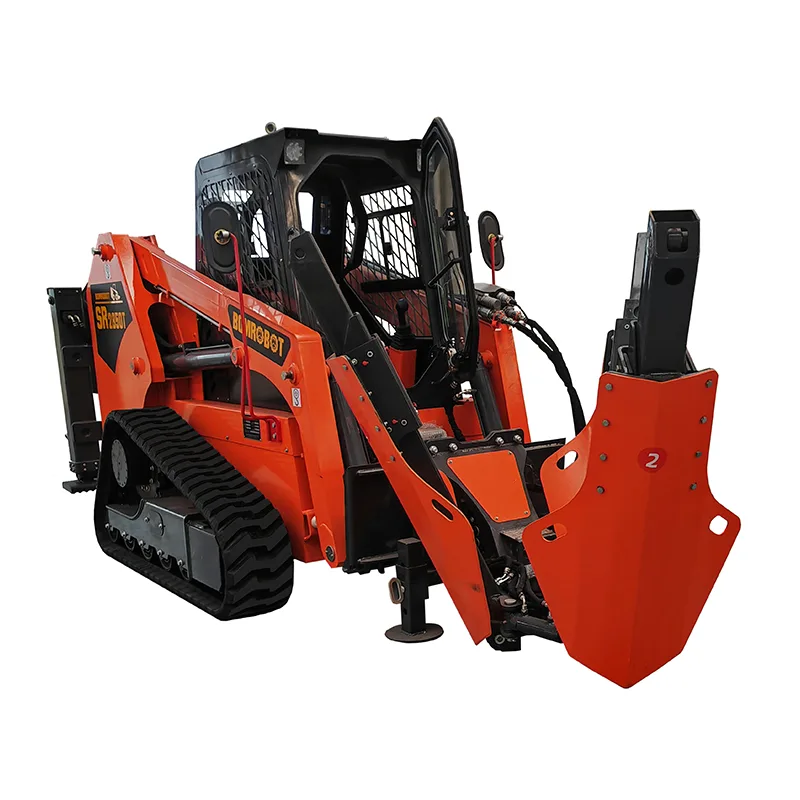
Consider HCN's SR770T Mini Track Skid Steer Loader.
Its published specifications list:
Attachment hydraulic flow: 45–60 L/min.
Attachment oil supply pressure: 18 MPa.
The SR770T's published flow range is below the 0209H Snow Blower's stated minimum of 75 L/min.
Therefore, based on the published figures, the SR770T should not be assumed to be a suitable hydraulic match for this snow blower.
This example demonstrates why buyers must compare the exact machine specifications with the exact attachment model.
6.2 Check Operating Pressure
Hydraulic flow and pressure perform different functions.
Flow determines the amount of hydraulic oil supplied over time, while pressure relates to the system's ability to generate hydraulic force and torque.
The 0209H Snow Blower lists a maximum allowable pressure of 20 MPa.
The 0208I Snow Blade lists a working pressure range of 14–21 MPa.
These figures should not be interpreted as interchangeable hydraulic requirements.
The machine's available pressure, flow, circuit configuration, and attachment manufacturer's operating limits must all be checked.
6.3 Check the Hydraulic Connections and Electrical Controls
Before ordering, confirm:
Auxiliary hydraulic connection type.
Hydraulic hose arrangement.
Coupler size and connection standards.
Return-line and case-drain requirements, if applicable.
Electrical control compatibility.
Chute control requirements for the snow blower.
Machine mounting plate or wheel-loader coupler dimensions.
For the snow blower, HCN also specifies electro-hydraulic control options. Buyers should confirm the required control system for the exact carrier machine.
7. Machine Compatibility: Skid Steer Loader or Wheel Loader?
Carrier compatibility should be verified before purchasing either attachment.
The HCN website lists multiple machine platforms, including skid steer loaders, compact loaders, wheel loaders, backhoe loaders, and excavators.
However, this does not mean every snow attachment is automatically suitable for every platform.
For example, the 0209H Snow Blower specification identifies high-hydraulic-flow skid steer loaders, while other sections of the product page contain wheel-loader coupler references.
The 0208I Snow Blade page also includes wheel-loader mounting references.
This means buyers should request confirmation of the exact machine configuration rather than relying on a general product category.
Provide the following information:
Machine manufacturer and model.
Machine operating weight and rated operating capacity.
Auxiliary hydraulic flow.
Maximum hydraulic operating pressure.
Mounting plate or coupler dimensions.
Electrical control configuration.
Required working width.
Intended snow removal application.
For distributors purchasing multiple units, it is particularly important to confirm compatibility for every machine model included in the intended sales program.
8. Practical Purchasing Checklist for Dealers and Contractors
Before placing an order, review the following points.
Machine and hydraulic requirements
Confirm the exact carrier machine model.
Obtain the actual auxiliary hydraulic flow.
Confirm hydraulic pressure.
Check mounting and coupler dimensions.
Verify electrical control requirements.
Confirm attachment operating weight against machine capacity.
Application requirements
Identify typical snowfall conditions.
Determine whether snow needs to be pushed or thrown.
Evaluate available snow storage space.
Measure the required clearing width.
Consider parking areas, roads, sidewalks, and access restrictions.
Estimate operating hours and seasonal utilization.
Attachment and after-sales requirements
Confirm the exact attachment model.
Confirm the included hydraulic hoses and couplers.
Check wear-edge and skid-shoe replacement options.
Confirm spare-parts availability.
Request operating and maintenance documentation.
Confirm packaging, lead time, and export documentation.
For OEM orders, confirm color, logo, mounting, and packaging requirements.
For rental companies and equipment dealers, spare-parts planning is particularly important because winter attachments may be used intensively during a relatively short seasonal period.
9. Why Work With HCN Attachments for Snow Removal Equipment?
HCN Attachments Manufacture Co., Ltd. supplies engineering machinery attachments for international dealers, distributors, and OEM partners.
Its product portfolio includes snow removal, construction, forestry, road maintenance, and material-handling attachments.
The current snow removal range includes the 0209H Snow Blower and 0208I Snow Blade.
HCN's website describes its manufacturing and supply capabilities as including:
In-house cutting, machining, welding, assembly, and inspection.
Hydraulic and machine-fitment support.
OEM and ODM private-label options.
Custom mounting and branding.
Export packing and shipping documentation.
Spare-parts planning and after-sales coordination.
For international distributors, these capabilities are relevant when developing a seasonal attachment range or sourcing multiple configurations for different markets.
Rather than selecting a product based only on its catalog description, buyers should provide the target machine information and operating requirements so that the appropriate model can be confirmed.
Learn more about HCN Attachments Manufacture and its Snow-Removing Attachments.
10. Conclusion: Which Snow Removal Attachment Should You Buy?
There is no single best snow removal attachment for every operation.
A snow blade is a practical solution when the main requirement is to push and redirect snow across accessible surfaces.
A snow blower is more appropriate when snow needs to be collected and discharged to a controlled location, particularly when accumulations or limited storage space make continuous pushing less practical.
For equipment dealers, contractors, rental companies, and municipal fleet operators, the decision should be based on four main factors:
Snow conditions and clearing requirements.
Available working and snow storage space.
Carrier machine hydraulic capacity and operating limits.
Attachment dimensions, weight, and mounting compatibility.
HCN's 0208I Snow Blade and 0209H Snow Blower provide two different approaches to commercial snow removal.
By comparing their actual specifications and confirming machine compatibility before ordering, buyers can select equipment that better matches their seasonal operating requirements.
Looking for a snow removal attachment for your equipment fleet?
Contact HCN with your machine model, hydraulic specifications, required working width, and destination market. The HCN team can help confirm the appropriate attachment configuration and provide a quotation for your project or distribution program.
Contact HCN Attachments for a Quotation
Frequently Asked Questions
1. What is the main difference between a snow blower and a snow blade?
A snow blower collects snow with an auger and discharges it through a chute. A snow blade pushes snow forward or sideways. Snow blowers are useful when controlled snow relocation is required, while blades are suitable for routine pushing and clearing.
2. Is a snow blower better than a snow blade for heavy snow?
A snow blower is often more suitable for heavy or wet snow because it collects and throws the material rather than relying entirely on pushing. Actual performance depends on machine hydraulic capacity and operating conditions.
3. What hydraulic flow does the HCN 0209H Snow Blower require?
HCN lists a hydraulic flow range of 75–150 L/min for both the 0209H72 and 0209H84 models. The maximum allowable pressure is 20 MPa.
4. What sizes are available for the HCN 0208I Snow Blade?
The published models are 020860I, 020872I, 020884I, and 020896I, with overall widths ranging from 1,575 mm to 2,430 mm.
5. Can a standard-flow skid steer operate the HCN 0209H Snow Blower?
Not necessarily. The attachment requires 75–150 L/min according to its published specifications. The carrier machine must be checked against this requirement. A standard-flow designation alone does not establish compatibility.
6. Can a wheel loader use an HCN snow blower or snow blade?
Compatibility depends on the exact loader model, mounting interface, hydraulic system, and attachment configuration. Buyers should provide their machine specifications and obtain written confirmation from HCN before ordering.
7. Does the HCN Snow Blade require hydraulic flow?
The current 0208I product page lists a working pressure range of 14–21 MPa but does not provide a specific hydraulic flow range. Buyers should request confirmation of the required hydraulic configuration for their exact machine.
8. What information should I provide when requesting a snow attachment quotation?
Provide the machine manufacturer and model, hydraulic flow, operating pressure, mounting configuration, required attachment width, quantity, and destination country. This information helps HCN evaluate fitment and recommend the appropriate configuration.

 +86 185 5285 3111
 +86 185 5285 3111
 nancy@hcn-tech.com
